Can you download Snapchat videos legally?
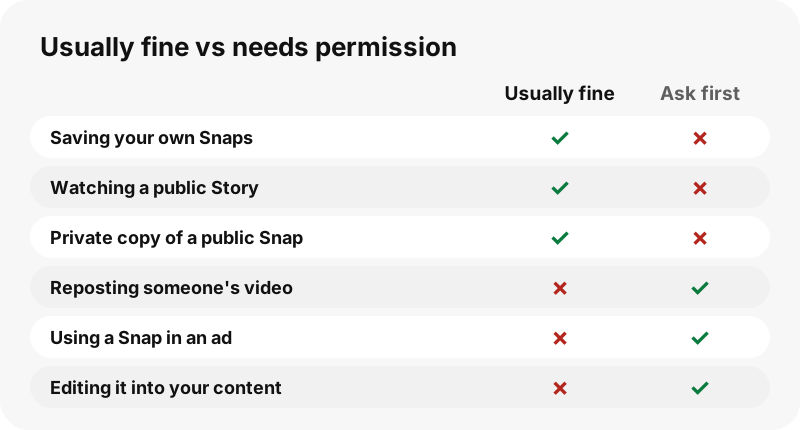
It depends on whose video it is and what you do with the copy. Saving your own Snaps is plainly fine.
Saving someone else's public video for private viewing is a grey area in most countries: it is rarely pursued, but the video is still protected by copyright. Reposting, editing or selling it without permission is where real legal risk starts.
This is not legal advice. It is a plain-language summary of public sources, written for a general audience. Laws differ between countries; if a specific use matters to you, ask a lawyer where you live.
Who owns a Snapchat video?
The person who made it. Snap's Terms of Service say that users keep ownership of what they post, and give Snap, not other users, a licence to use it to run the service.
“When you do that, you retain whatever ownership rights in that content you had to begin with.”
That licence covers Snap and its affiliates. Nothing in it hands viewers a right to copy or republish someone else's Snap. So when you download a public video, you hold a copy of a work that still belongs to its creator.
Is a short Snap really protected by copyright?
Usually, yes. In the United States, copyright protects original works from the moment they are fixed, and a video recorded on a phone is fixed the moment it is saved. The U.S. Copyright Office lists photographs and movies among the protected types of work.
Internationally, the Berne Convention, which most countries have joined, sets the same principle. WIPO's summary of it lists automatic protection as one of three basic rules:
“Protection must not be conditional upon compliance with any formality”
No registration, watermark or copyright notice is needed. A ten-second Story of a sunset can be protected just like a film, although very short or purely factual clips may have thin protection.
Does "public" mean free to use?
No. Public means anyone may watch it; it does not mean anyone may copy and reuse it. A song on the radio and a photo on a billboard are public too, and both stay under copyright.
Snap's own reminder is that anyone can screenshot or record a Story. That describes what is technically possible, not what is legally allowed. The creator's permission, or a legal exception, is still what makes reuse lawful.
What does fair use mean for Snapchat downloads?
In the United States, fair use is the main exception that lets people use protected works without permission. The U.S. Copyright Office explains that courts weigh four factors, and no single factor decides the case.
| Fair use factor | What courts look at | How a typical download fits |
|---|---|---|
| Purpose and character | Commercial or not; transformative or a plain copy | Private viewing is non-commercial but not transformative |
| Nature of the work | Creative works get stronger protection | Most Snaps are creative |
| Amount used | How much of the work is copied | A download copies the whole video |
| Effect on the market | Whether the use harms the owner's market | Little effect if kept private; real harm if reposted for views or money |
The table shows why a private copy and a repost are so different. The same file kept on your phone touches the market very little; uploaded to your own account for views or ad money, it can compete directly with the creator.
Is it different in the UK and other countries?
Yes, often stricter. The UK has no general fair use; it has narrower "fair dealing" exceptions for things such as private study, criticism, review, news reporting and parody. The UK government's guidance on private study is blunt about whole copies:
“Such use is only permitted when it is ‘fair dealing’ and copying the whole work would not generally be considered fair dealing.”
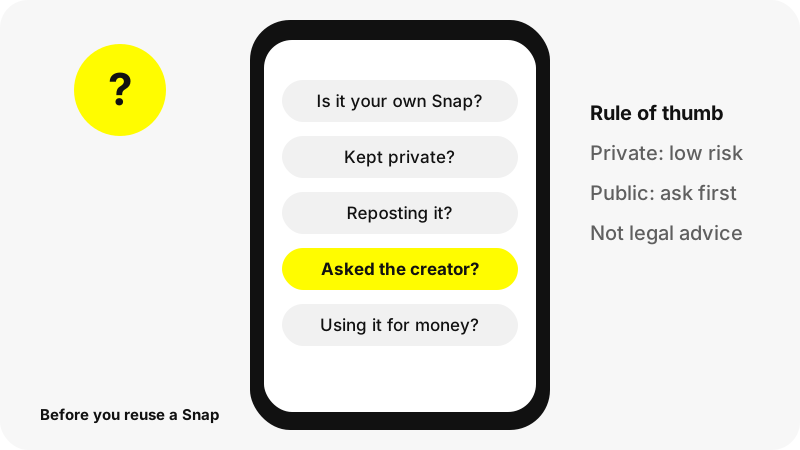
Other countries have their own exceptions, and they differ in scope and conditions. Because the rules vary so much, the safest habit is the same everywhere: keep copies private, and ask before anything leaves your device.
What uses are lower or higher risk?
Thinking in terms of risk rather than a simple yes or no is more honest. The table orders common uses from the safest to the most likely to cause trouble.
| What you do | Risk | Why |
|---|---|---|
| Save your own Snaps | None | You own them |
| Watch a public Story in a browser | Very low | Viewing is what public posting allows |
| Save a public Snap for private viewing | Low, but not zero | A full copy of a protected work, with no market harm |
| Share it privately with a friend | Low to moderate | A further copy, outside the creator's control |
| Repost it publicly with credit | Moderate to high | Credit does not replace permission |
| Repost it as your own, or use it in ads | High | Infringement plus possible false endorsement |
| Use it to mock, track or harass someone | High | Can break harassment and privacy laws |
Does giving credit make reposting legal?
No. Credit is good manners and often expected, but it is not a licence. Writing "all rights to the owner" or "no copyright intended" under a reposted video does not change who owns it or create permission that was never given.
The reliable route is to ask. Most creators answer a polite message, and many are happy to be featured when they are asked and credited. Keep the reply, in case the post is ever questioned.
What about the people who appear in the video?
Copyright is only one layer. A Snap often shows people who are not the creator, and many countries protect a person's image, privacy or personal data separately. Reusing someone's face in an ad, or circulating a video to embarrass them, can be unlawful even where copyright is not the issue.
Never use a viewer or a downloader to monitor, track or harass a person. SnapViewer shows only public posts, never locations, friend lists or private Stories, and it is built for watching and personal saving, not surveillance.
What can a creator do if their video is reposted?
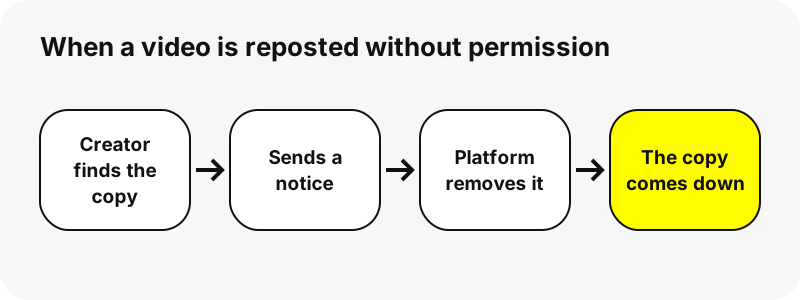
Report it. Snapchat has separate tools for copyright and trademark complaints, and Snap's help centre is careful to say that unclear cases may need advice first.
Outside Snapchat, many platforms accept copyright notices under the U.S. DMCA or similar laws, and remove the copy after a valid notice. For SnapViewer specifically, rights holders can block a profile or a single Spotlight video through our copyright and opt-out page; blocked content is refused with HTTP 451 and old download links stop working.
Is it legal to use SnapViewer itself?
SnapViewer reads only what Snapchat publishes on public profile pages, without logging in, and stores no files: each download streams from Snapchat's servers through a link that expires after one hour. You never give us a Snapchat password, so no Snapchat account of yours is involved.
Our terms allow personal, non-commercial use: watching public Stories, keeping copies of your own Snaps and saving public Snaps for your own viewing. Snap's own terms continue to apply to how you use Snapchat.
To start, use the Snapchat video downloader or the story downloader. To understand what a viewer can and cannot reach, read are Snapchat viewer sites safe.
SnapViewer is independent and is not affiliated with, endorsed by, or connected to Snap Inc. Account owners can ask us to stop showing their profile at any time.
Frequently asked questions
Is it illegal to download someone else's Snapchat video?
Not automatically, but the video is protected by copyright. A private copy is low risk in most places; reposting or selling it without permission is not allowed.
Can I download my own Snapchat videos?
Yes. You own your Snaps, and you can save them in the app or with a public viewer if your profile is public.
Is it legal to screenshot a Snapchat Story?
Taking it is technically possible, as Snap notes. The same copyright rules apply to what you then do with the screenshot.
Does giving credit let me repost a Snap?
No. Credit is not permission. Ask the creator first and keep their answer.
Is downloading a public Spotlight video fair use?
It might be for private viewing in the US, but fair use is decided case by case. Reposting for views weighs against it.
Can I get in trouble for reposting Snapchat videos on TikTok or YouTube?
Yes. Creators can send copyright notices, and platforms usually remove the copy after a valid notice.
Does Snapchat own the videos posted on it?
No. Snap's terms say users keep ownership of their content and give Snap a licence to run the service.
Do I need a watermark or registration for my Snaps to be protected?
No. Under the Berne Convention, protection must not depend on formalities such as registration.
Is it legal to use a Snapchat viewer site?
Watching public content is what public posting allows. Use honest tools that need no login and keep saved files private.
Is this legal advice?
No. It is a general explanation of public sources. For a specific situation, ask a lawyer in your country.
Is SnapViewer part of Snapchat?
No. SnapViewer is an independent tool and is not affiliated with Snap Inc. It only reads public profiles.
How do I stop SnapViewer from showing my videos?
Use the copyright and opt-out page. We block the profile or the single video, and old download links stop working.
Guides
Story viewer — Type a username to watch a public profile's Stories, Spotlight and Highlights.
Sources
- Terms of Service — Snap Inc.
- What is Copyright? — U.S. Copyright Office
- U.S. Copyright Office Fair Use Index — U.S. Copyright Office
- Summary of the Berne Convention for the Protection of Literary and Artistic Works — WIPO
- Exceptions to copyright — GOV.UK
- About Reporting Infringement on Snapchat — Snapchat Support
- Privacy by Product: Stories — Snap Inc.